
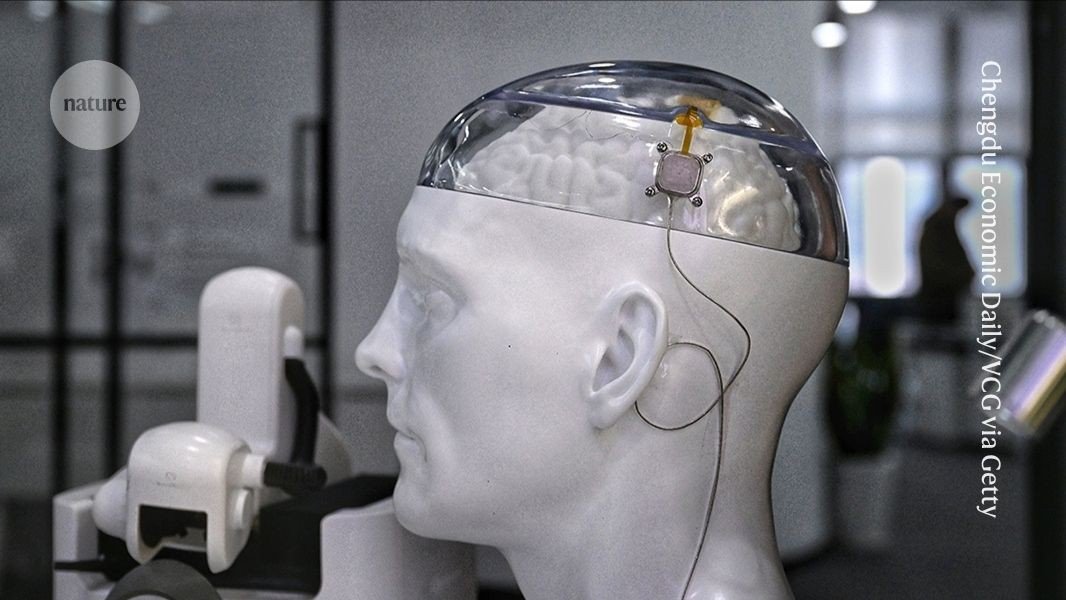

A brain-computer interface developed by Chinese company NeuroXess.Credit: Chengdu Economic Daily/VCG via Getty
Chinese companies are racing to develop and deploy artificial-intelligence powered brain–computer interfaces (BCIs) that can help people to move, speak and control devices.
BCIs, which link a person’s brain to an external device or a computer using sensors placed around or inside the head, have been used in people who are paralysed and those with neurodegenerative diseases over the past decade.
In the past few years, companies, mostly in China and the United States, have added large language models to their brain devices. This enables scientists to decode brain activity more accurately than can be achieved using conventional signal-processing and data-analysing technologies, says Li Haifeng, a neuro-computing scientist at Harbin Institute of Technology in China.
In China, trials in small numbers of people are underway and some AI-powered brain devices will soon be sold to the public.
First trials in people
NeuroXess in Shanghai is one company in China that has run small clinical trials, including on their AI-powered brain implant can assist people with paralysis. The implant is placed on top of the skull, and its sensors are fitted on the brain’s outer layer, called the cerebral cortex. The system is then connected by wire to a data transmitter that doubles as a battery, which is embedded in the recipient’s chest.
In a trial in October, a 28-year-old man with a spinal cord injury who was fitted with the brain implant was able to control appliances by moving a computer cursor with his thoughts to turn them on and off using an app.
The company has also developed a large-language model to enable a brain implant to decode Mandarin in real time at a rate of 300 characters per minute. This is faster than the average talking speed of a person who speaks Mandarin as a first language, which is around 220 characters per minute. The AI model generated words and phrases for a 35-year-old woman with epilepsy, says Tiger Tao, co-founder and chief scientist at NeuroXess. The firm’s team of researchers are now writing up papers about the trials, he says.
Government backing
The Chinese government has stated that it wants to be a global leader in BCIs by the end of the decade. It wants researchers to make major technical breakthroughs in BCIs by 2027 and to produce two or three world-class firms by the end of the decade. The country approved the world’s first commercial brain implant in March.
But the fast-moving neurotechnology has raised concerns about how companies will handle users’ private data, particularly when devices are combined with AI. In China, the government has been proactive in developing guidelines that companies or researchers must follow, says Tao. The government released a set of ethical guidelines for BCIs in 2024, which requires written consent from participants of clinical trials or their guardians and for the trial to pass an ethics assessment.
In China, people are used to companies having access to their data and are more tolerant of, and willing to experiment with, new technologies despite privacy concerns, says Meicen Sun, an information scientist at the University of Illinois Urbana-Champaign.
Because Chinese companies have access to personal data, they can use it to improve their technologies and the user’s experience, which, in turn boosts people’s confidence, making them more willing to give their data, says Sun. “It’s a self-reinforcing loop,” she adds.